
Something unusual is happening to one of the most routine preventive healthcare behaviors in America. Despite an enormous body of research that supports the safety and effectiveness of vaccines, they have become an increasingly polarizing topic in the United States since COVID-19. The current administration has consistently questioned the value of preventive care, leading to confusion and increasing resistance in many groups. The skepticism of vaccines appears to have led to a politicization of one of the most common public health interventions, the annual flu shot.
Flu is one of the top causes of death among seniors. About 1% of U.S. seniors will find themselves hospitalized for the condition in any given season at a cost of approximately $22,000 per stay. Nonetheless, the share of seniors getting flu shots is dropping. CMS Star Rating Data, which reports on quality measures across Medicare Advantage plans, shows the average share of members across plans reporting having had a flu shot falling every year from measure year 2022, 73.0%, to measure year 2025, 64.6%.
As we head into election season, healthcare leaders must recognize that the political environment can shape how members receive health communications, making the timing, tone, and delivery of preventive health outreach especially important.
A Shifting Vaccination Landscape
The changes in vaccine rates, however, are not evenly distributed across the country. Adults in Republican-leaning states have become less likely to receive flu shots, while residents of more Democratically leaning states are now more likely to be vaccinated.
It appears as though flu shots, once a fall rite of passage, have become a form of partisan expression.
Figure 1: 2016 – 2027
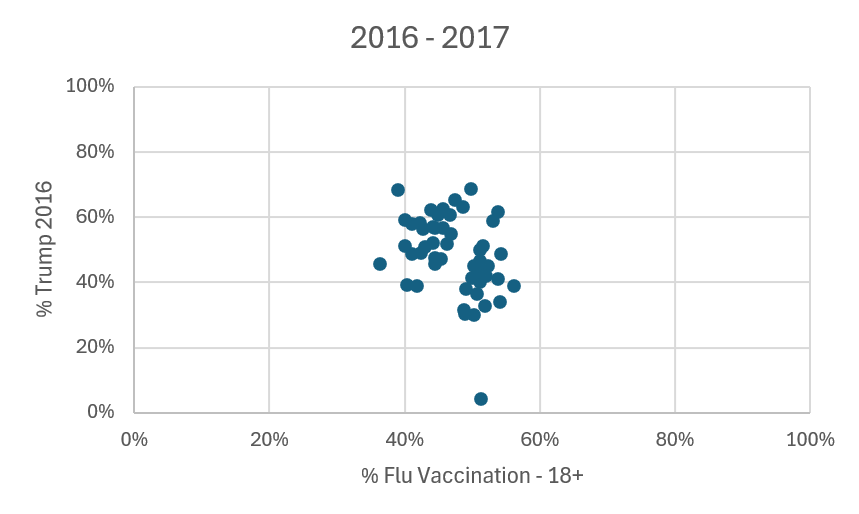
The horizontal axis shows vaccination rates among adults 18 and older by state, including the District of Columbia, from the CDC for the 2016 – 2017 flu season. The vertical axis shows the percent of voters casting ballots for Donald Trump in 2016 by state, as reported by the University of California Santa Barbara.
Looking at the data, there does not appear to be much of a pattern. The correlation is a modest -0.36.
The picture changes in 2024.
Figure 2: 2024 – 2025
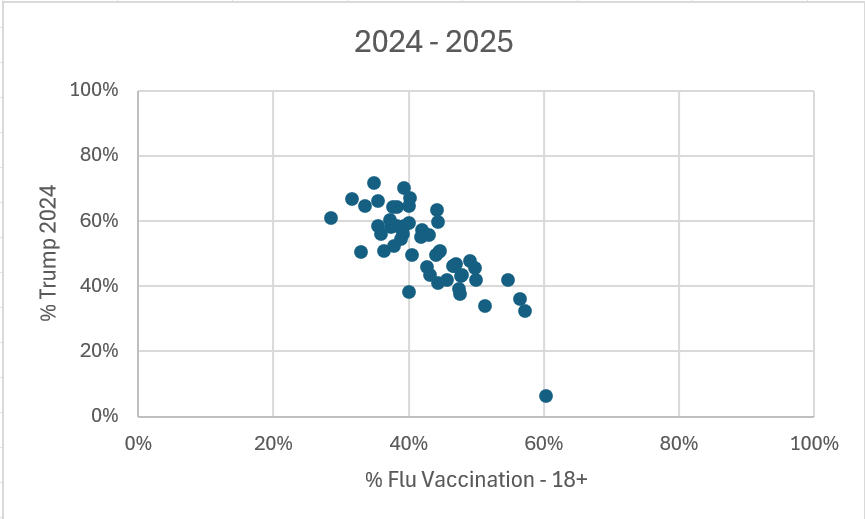
A glance at the chart reveals a line emerging from the data. The correlation jumps to -0.79, a meaningful relationship.
Consistent with the CMS Stars data, the average adult vaccination rate across states fell nearly five points from 47.3% to 42.6%, meaning that significantly fewer US adults are getting vaccinated against the flu.
The data also suggests a growing gap between high vaccination rate states and lower vaccination rate states. The range from high to low in 2016 – 2017 was 56.1% to 36.3%. In 2024 – 2025, the difference became 60.3% to 28.6%. Some states moved dramatically in directions consistent with political leanings. South Dakota fell from 4th in 2016 – 2017 to 21st. Simultaneously, Oregon moved in the opposite direction from 47th to 20th.
It is not surprising that states vary. States differ substantially in demographics, healthcare access, public-health infrastructure, policy, and other factors that can influence vaccination. These state-level correlations do not demonstrate that political affiliation causes vaccination behavior. The bifurcation is interesting, and the growing association is sufficiently pronounced to merit attention from healthcare leaders.
Six New England states and three West Coast states have established their own public health alliances to combat perceived failures at the federal level.
If these trends continue, declining vaccination rates could carry significant implications for utilization, health outcomes, quality performance, and healthcare costs in low vaccination rate states.
What Healthcare Leaders Can Do
Rethink segmentation.
Identify where preventive-care gaps are widening and distinguish barriers such as access, convenience, complacency, safety concerns, and institutional distrust rather than treating the unvaccinated as a homogeneous population. Political affiliation isn’t necessarily a targeting variable, but healthcare leaders should lean into the idea that communications strategies need to recognize that identical preventive-care messages may land differently in different communities.
Be mindful of channel & timing.
Even well-designed outreach can miss the mark if the channel or timing clashes with what members are experiencing outside of healthcare. Election season is a good example. Automated calls and other high-frequency outreach may compete with a surge of political communications, particularly in heavily contested states or districts. Health plans should consider the broader communications environment when planning preventive-care outreach and assess whether adjusting the timing, channel, or frequency could help their message break through.
Test the messenger, not just the message.
The organization delivering the recommendation may matter as much as the language itself. Health plans should examine whether clinicians, pharmacists, community organizations, employers, or other trusted voices perform differently across member populations. One example of new, unconventional partnerships focused on driving preventive care is the dating app Grindr’s recent acquisition of PurposeMed, the parent company of Freddie, a sexual health platform that provides access to HIV prevention care through telehealth services. The rationale builds on trust and community: “Grindr has a direct line to millions of gay men, and Freddie brings the medical expertise to turn that reach into care.” The hookup creates a trusted community aimed at improving access to care. With many institutions and organizations facing scrutiny and skepticism, it’s time for public health leaders to consider new channels and new messengers.
Treat trust like a measurable healthcare experience variable.
It’s well established that vaccines continue to be a polarizing topic. The operational challenge for healthcare organizations is earning enough trust to influence behavior despite that polarization. Connect attitudes and engagement signals with actual preventive-care behavior and continuously test which approaches move members from intention to action.
Focus on behavior rather than politics.
Healthcare organizations do not need to enter a partisan debate. They need to understand the barriers driving behavior and design outreach around those barriers.
Keeping Prevention Above Politics
Preventive care should not become another casualty of political polarization. If vaccinations and other preventive care measures are increasingly shaped by political and cultural identity, health plans, providers, and public-health organizations may need to rethink how they communicate about prevention. A nationally standardized message may be progressively less effective across populations whose trust, motivations, and information environments differ substantially. We should be working together to promote preventive care, particularly low-cost, highly effective interventions that save lives, like vaccines.