

Most national health plans are investing heavily in member experience and engagement, and losing tens of millions of dollars each year due to invisible system failures. One plan reversed this trend in under six months, not by expanding outreach, but by diagnosing and fixing where engagement breaks. Here’s how.
The Core Problem
Most engagement campaigns lose value at predictable points: solving for too many problems, targeting the wrong members, using the wrong channels, sending messages at the wrong time. These aren’t creative failures; they’re system failures. But these failures aren’t mysterious—they’re measurable, diagnosable, and fixable.
Engagement Funnel Framework
Engagys’ Engagement Funnel Framework is the foundation of our agile engagement and behavior change approach. The funnel brings together the full set of elements required for effective engagement and user experience design, from high-level strategy to tactical execution of messaging and design. Each layer is anchored in data, behavioral science, and A/B testing. A breakdown at any layer of the funnel cascades downstream, eroding ROI at every subsequent layer. Our highest performing plans partner with us to use this as a diagnostic system, continuously learning and iterating to drive behavior change and ROI at scale.
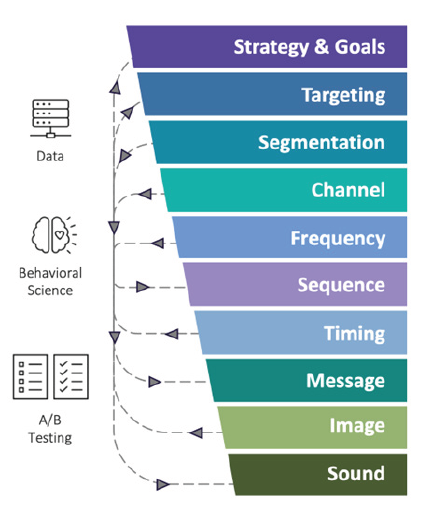
Where Engagement Breaks and How to Fix It
Breakpoint
Vague goals or trying to accomplish too much at once means no clear way to measure success or optimize performance.
The Fix
Commit to a single, outcome-level objective that the organization is willing to manage to, not a list of initiatives. This requires leadership alignment on what matters most now, agreement on the success metric, and the discipline to deprioritize everything else.
For example, “reduce avoidable ER visits by 20% this quarter” provides a clear north star that informs every downstream decision, from targeting criteria to message testing. Without a clear north star teams optimize locally, campaigns drift, and performance cannot be meaningfully evaluated or improved.
Impact
If a campaign can’t state its one goal and metric, it’s not ready to launch. High performing plans treat goal clarity as a governance issue, not a creative brief. Clear goals enable rapid iteration and measurable ROI.
Breakpoint
Broad campaigns dilute impact and waste budget on reaching audiences who may not yet have the need, urgency, or ability to act.
The Fix
Target on need. Shift from population scale outreach to need-based prioritization, deciding who not to reach as deliberately as who to engage. This requires leadership support for narrower audiences, even when broader reach feels safer. In cost-of-care initiatives, Engagys often prioritizes high-utilization or high-risk members.
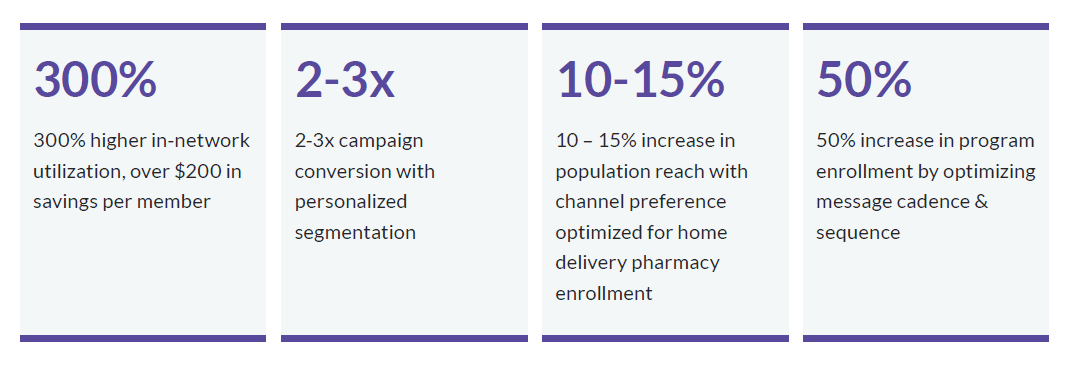
For one plan, members with documented MRI needs were prioritized, achieving 300% higher in-network utilization. For another client, we averaged an estimated $200 in savings per member by shifting site of care for a high-utilizer population.
Impact
Targeting on need requires confidence in data, analytics, and clinical alignment. Plans that make this shift unlock disproportionate ROI by focusing resources where behavior change is most likely to move cost and outcomes.
Breakpoint
Treating all targeted members the same, despite differing barriers and motivations, produces suboptimal results across the board.
The Fix
Invest in behavior-based segmentation, not demographic grouping. This means authorizing teams to design different experiences for different member mindsets, even within the same program.
For example, members hesitant to adopt biosimilars may simply lack awareness, while others may fear reduced effectiveness. One plan tailored messaging to these distinct barriers within a campaign and more than doubled switching rates from branded drugs to generics.
Impact
True segmentation introduces complexity and requires more coordination. Most organizations avoid segmentation for operational simplicity. High performing plans accept complexity upfront to avoid mediocrity at scale, and see higher conversion as a result—often 2-3×1 the conversion of a one-size-fits-all approach.
Breakpoint
Over-reliance on a single channel or misalignment with member preferences means messages never reach their intended audience.
The Fix
Move from channel ownership models to member preference models paried with a coordinated, multichannel approach informed by past engagement behavior. This requires leaders to break down silos across digital, call center, mail, and vendor teams to coordinate outreach as a single system.
Impact
Poor channel performance is a signal to pivot, not to abandon the goal. Channel optimization alone can unlock 10-15%1 of lost engagement for many outreaches.
Breakpoint
Reaching members too late, too often, or with the wrong communication sequence undermines even perfectly crafted messages.
The Fix
Treat timing, frequency, and sequence as strategic levers, not operational details. This requires leadership endorsement of experimentation, testing, and learning, even when it disrupts standard outreach playbooks.
For one plan, Engagys increased program enrollment 50% across their male population simply by testing delivery sequence and sending a letter before a follow-up call, compared to 20% when calls came first.1 Same content. Same members. Better results.
Impact
Most organizations default to static schedules because they feel predictable and controllable. High performing plans recognize that when and in what order members are engaged often matters more than what is said, and authorize teams to optimize accordingly.
Breakpoint
Messages that are unclear, irrelevant, or fail to communicate value get ignored, no matter how many times they’re sent.
The Fix
Hold messaging accountable to behavior change, not brand expression alone. Leaders must insist that every message answers a simple question from the member’s perspective: Why should I act now?
Personal cues, like referencing a member’s physician by name, have increased response rates by 10-20% in various programs.1 Pairing tactics like personalization with subject line testing, and benefits framing can significantly increase engagement rates within 1-3 test cycles.1
Impact
Content is often treated as subjective or qualitative, making it hard to challenge. Executives who demand measurement, testing, and iteration elevate content from a creative asset to a performance driver, and unlock fast, low cost gains in engagement.
Breakpoint
Poor visual design or clunky user experience creates friction that stops members from completing desired actions.
The Fix
Prioritize usability and accessibility as core drivers of ROI, not downstream polish. This requires leadership support for human centered design standards, testing, and simplification, even when it means revisiting “finished” assets. Communications should be mobile-friendly, visually clear, and focused on a single action. Even subtle design changes, such as adjusting voice or visual cues to better match the audience, can improve engagement and member experience.
In a recent Engagys project, design updates for a national plan informed by the Patient Education Materials Assessment Tool (PEMAT), human-centered design principles, and behavioral science increased scores for understandability by 200% and actionability by 100%
Impact
Friction is expensive but invisible on P&Ls. Leaders who treat experience design as a strategic investment systematically reduce drop off and improve follow-through, especially among vulnerable and high-need populations.
Client Results Achieved with the Engagement Funnel Framework
The Bottom Line
Every day your engagement strategy leaks value. Every untested message, every mistimed outreach, every friction point in the user experience increases the cost of care and impacts your members’ health outcomes.